Why marketing's obsession with sentiment misses how people actually hire a drink.
The stage moment
Coca-Cola's chief marketing officer, Manolo Arroyo, stood on stage at the ANA Masters of Marketing conference and said: "With age and with experience, I do not believe anymore in love."
For 20 years, from 2000 to 2020, he said, Coca-Cola's key marketing metric was brand love. "Many times we were seeing increases in brand love when the business performance was going downwards." Millions of people claim they truly love Coca-Cola. They "wear very proudly a T-shirt," and "will never consider drinking a Coke."
So Coke switched to a behavioral metric: how many people actually drink it.
It is easy to read this as an obituary for brand love. I read it differently. Arroyo didn't kill love. He found out you cannot buy it as an input.
That is Fake Plastic Love: affection you count in a sentiment survey and see on a retro T-shirt, completely disconnected from the moment someone opens the fridge.
That moment is where loyalty is decided. And it starts with stress, not affection.
Counting drinkers gets closer to reality. But a behavior metric carries its own blind spot. People drink what is right there, on autopilot, until something solves the exact same problem without charging the physical cost. Then the behavior walks away.
What people actually hire a drink for
We measured what people in the US search for, post and buy across 60 kinds of drinks. The fastest growth is not in a shiny new flavor or an expensive brand campaign. It is in jobs, and almost every single one of them is bodily maintenance.
- Get me back to normal. Google searches for electrolytes around sickness or hangovers jumped at least 88% in a year, to about 270,000 a month. They peak in the thick of flu season.
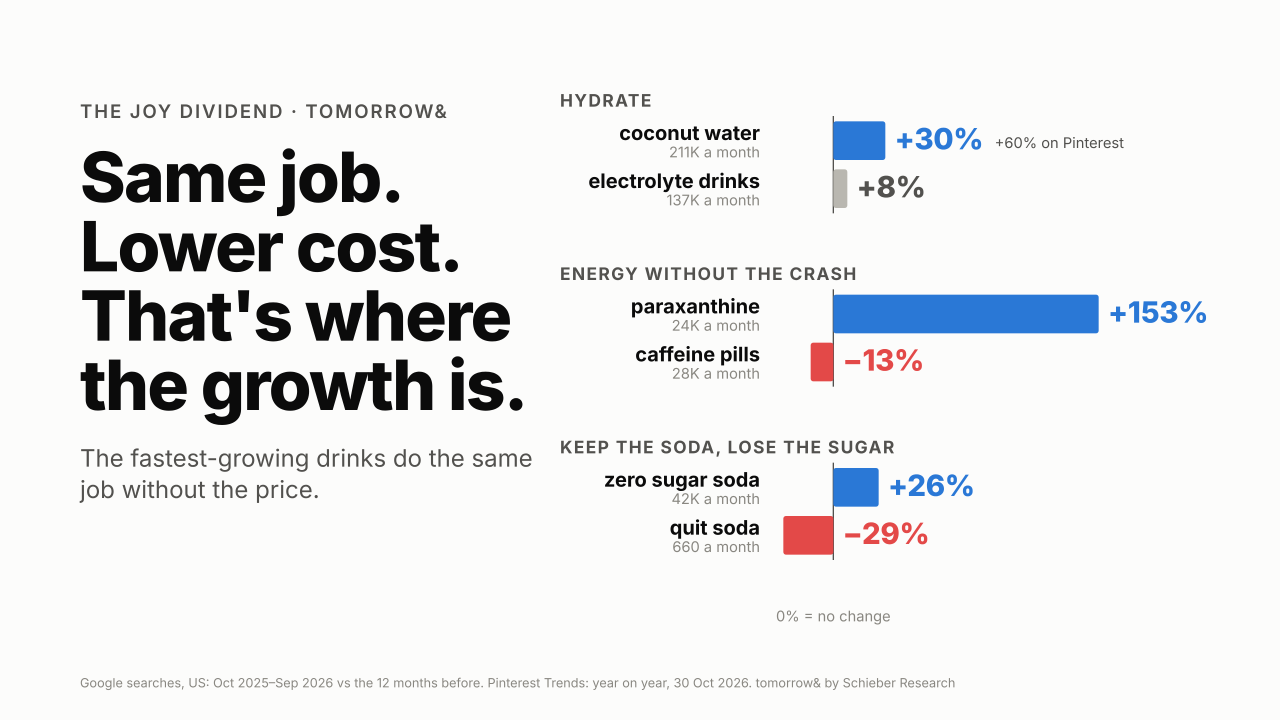
- Keep me going without the crash. Searches for paraxanthine, marketed as caffeine without the jitters and the afternoon crash, surged 153%, while searches for traditional caffeine pills fell 13%. It is still an emerging market at about 24,000 searches a month, and it kicked off with a single brand launch (Kim Kardashian's Update). But curiosity sustained long after the launch hype faded: queries for "what is paraxanthine" are searched nearly 6 times more often than a year ago.
- Keep things moving. Searches for fiber drinks and powders are up 46%. In the social comments, the recurring trigger is bloating.
None of these purchases is an indulgent treat. Every single one is relief: a body that needs maintenance, a workday that demands surviving, a flu season that would not quit. This is the Emotional Economy in a can. Consumers spend their mental bandwidth and dollars on products that take an immediate physical strain off their plate.
The trap: hired isn't loved
A drink that gets the job done can still punish the person drinking it.
Under a TikTok video breaking down electrolyte routines (with roughly 3 million views), one top comment reads: "electrolytes are DISGUSSSSSTING." Nearly 2,000 people liked it. Another user chimed in: "Hating the taste of electrolytes saved me again."
That is a paying customer. It is not a fan. The job gets done, but the buyer pays twice: once at the checkout counter, and once on their tongue.
This is the Calm but Joyless quadrant. Functional, reliable, and instantly replaceable. Consumers keep buying it simply because it works, but the explosive growth shifts to whatever solves the same biological problem without the penalty.
Watch the migration happen in real numbers. Searches for standard electrolyte drinks grew 8% this year. Coconut water surged 30% on Google and 60% on Pinterest. It handles the exact same hydration job, but tastes like something you actually want to swallow. Under that same TikTok video, a comment with over 16,000 likes put it plainly: "I actually cut liquid iv off and drink coconut water for dehydration."
The categories losing steam tell the exact same story from the opposite direction. Mushroom coffee dropped 20%. Wellness shots dropped 20%. They made big wellness promises that consumers simply could not feel or verify on the day they drank them.
Nobody is quitting soda
Here is the data point that shatters the clean-eating myth: there are only about 660 searches a month in the entire US for how to quit soda. That number is down 29%.
Overall soda searches are completely flat. Consumers are not abandoning the category. They are renegotiating the terms of engagement.
Some strip out the metabolic tax. Searches for Zero Sugar soda climbed 26%, and on Amazon those products are outpacing standard category velocity. As one reviewer wrote: "As a diabetic I appreciate the fact that there is Coke Zero. I can enjoy the occasional soda beverage and not raise my sugars."
Others put pure indulgence back into the glass. Dirty soda, standard soda spiked with cream, flavored syrup, and lime, exploded 152% on Google and 80% on Pinterest.
Both consumer shifts protect the ritual while ditching the tax. People want the emotional break and the carbonated lift. They refuse to pay for it in guilt, sugar spikes, or clinical boredom.
How we found this: tomorrow&, our research system
What brand leaders keep getting backwards
Arroyo is entirely right that love follows behavior. But he also identified the prerequisite that enables it. His stated first priority for building sustainable billion-dollar brands: "winning products with taste and functional superiority." Not taste or function. Both. Solving the consumer's problem without charging an experiential penalty.
Love follows one specific type of behavior: the kind that removes an existing friction without creating a brand-new one.
Most functional beverage brands still run that equation completely in reverse. They add complexity: more adaptogens, bolder health claims, a fourth functional promise crammed onto the aluminum label.
The first move in real product strategy is always subtraction. What friction does this beverage take off someone's shoulders? And what hidden cost are they paying to consume it? The chalky taste they have to choke down. The mid-day crash. The blood sugar spike. Or the pricing friction: enthusiastic fans of paraxanthine celebrate the "smooth subtle boost without the jitters," while simultaneously noting that the cans remain "much too expensive."
Legacy brand love surveys ask consumers how warm they feel toward a corporate logo. They never bother to ask the single question that dictates retention: what did it cost you in effort, discomfort, or compromise to drink this?
So what are you actually building: Fake Plastic Love that evaporates the second someone reaches into the cooler, or an earned dividend that compounds every time your product makes a consumer's day noticeably easier?
*US data via tomorrow&. Google: monthly searches, 12 months to September 2026 vs the 12 before; one-off spikes smoothed; searches that jumped to a new level in a single month are read after the jump ("at least"). Pinterest: Pinterest Trends, year on year, read 30 Oct 2026. Amazon: selling pace vs the last 90 days, Amazon US, read 30 Oct 2026. Quotes: TikTok comments, Jul–Aug 2026 (source); Reddit, r/decaf; Amazon US customer review. Coca-Cola: Manolo Arroyo at the ANA Masters of Marketing conference, 21 Oct 2026, as reported by Marketers & Money)
Download the Tomorrow& Drinks report here.
Explore the research
Read the Functional Drinks research and free preview for the category context, scope and methodology, or explore the full Functional Drinks Snapshot.