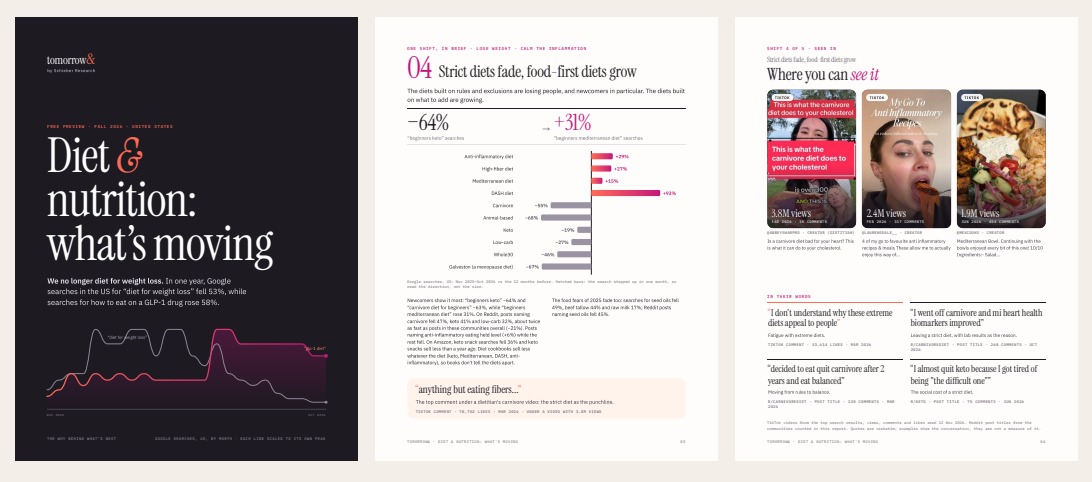
Your customer changed twice this year.
Better briefed by AI. Less trusting of everything it makes. Four needs shaping what people buy in 2027, why they have them, and where you can already see them.
AI is shaping what people want, just not where you’d look.
It gives people the words
People arrive at the shelf already knowing the name of their problem and the thing they want for it. Searches for the named treatment, the named condition and the named material are rising.
Here is how people describe it.
“Now it’s just do my own thing for normal stuff you can do with GPT (most always gut related) and leave the big stuff for the doctor as well as knowing what to tell him and ask to be tested for when I do have an issue.”
“I gave my lease agreement to chatgpt and asked it if there was anything I could use to help myself.”
And it makes them doubt what is real
People have started checking.
Google searches, US: average a month Oct 2025–Sep 2026 and change against Oct 2024–Sep 2025. † most of the change arrived in one month: read the direction, not the size.
So they reach for what cannot be faked: something with weight, something made badly by hand, a table with other people around it.
Our reading. The searches above are measured. The link between them is ours: an assistant that answers anything hands people the vocabulary, and a feed where everything looks finished and perfect raises the value of what is plainly real and plainly imperfect. The four needs that follow are what we see it lead to.
Your customer changed twice this year: better briefed, and less trusting. A product now has to be specific enough to survive the briefing and real enough to survive the doubt.
Products rotate. Needs last.
A hit product has a short life. The need behind it stays, and moves on to the next product, often in another aisle. Follow the need and you can see the next product coming.
Squishmallows, then Labubu, then squishy toys: three objects in five years, each rising as the last one faded, all serving the same need. Labubu went from nothing to its peak and back in about eighteen months.
A real answer for my situation
“I want this properly dealt with, so I look for the answer made for my situation.”
The why: relief People describe years of being told it was nothing, or of blaming themselves. A real answer, with a name, ends the wondering. From then on they look for what was made for their situation.
People want their specific situation taken seriously. A product or a service that says plainly which situation it was built for is easier to find and easier to trust.
Ask yourself: Which situations in your category change what the product has to do? Those are the ones worth naming on the pack and the page.
Seen on TikTok
Tap a card to watch on TikTok. Views as read in November 2026.
“…I realized all of my struggles stemed from complications of my ADHD instead of some personal moral failing…”
The named treatment and the number
People are choosing treatments with a name and ways to measure themselves. General wellness is easing at the same time.
“It's a common thing for doctors to reject HRT requests because [they] are simply untrained in menopause.”
Where the words come from
Some now get there with an AI assistant. In the Reddit threads we read, people describe typing in their symptoms and test results, then taking what they learned to a doctor. They describe using it to prepare for the professional far more often than to replace one.
“While GPT didn't actually diagnose me, it DID point me in the exact right direction for doctors to finally diagnose me after so many tried and failed.”
These threads come mostly from a community of ChatGPT users. They show how people describe it, not how common it is.
The product made for my situation
The same need reaches the shelf. Searches rise where the situation changes what the product has to do: how someone sleeps, what their skin reacts to, where it hurts. Among searches for side sleepers, 26 of 34 are up. Labels that describe the shopper without changing the product are easing.
On the shelf. Many of the leading pillows for side sleepers are new listings this year. Amazon US, sales rank of the leading products, Nov 2025–Oct 2026 against the year before.
“The label “petite” helps some women find clothing that fits them better. The label “adhd” helps some people understand themselves better, and helps them find doctors who specialize in helping them.”
Tomorrow morning
- Look. Search your category followed by “for” and list the situations people name. Check each one in Google Trends.
- Ask. Which of our audience labels are types, and which are situations that change what the product has to do?
- Test. Lead one listing title or search ad with the situation, and compare it with the current one.
Worth the money
“I want the good one without paying for the name, so I buy it used, fix it, or find the match.”
The why: control People trust their own judgment over the price tag. They say older things are better made, that they can tell when a lower-priced version is just as good, and that they will not rent what they have already bought.
This buyer is spending carefully and proudly. What earns the full price is what cannot be matched or bought used: service, repair, the part of the product that keeps getting better.
Ask yourself: What do people find when they search your brand with “dupe” or “worth it”?
Seen on TikTok
Tap a card to watch on TikTok. Views as read in November 2026.
“I also don't like buying new - everything declines in quality over the years so I prefer to buy well-made items.”
Used, repaired, matched
Second-hand, repair, refurbished and the well-chosen match are rising together, from clothes to appliances to phones.
“I can tell zero difference because I’ve owned them at the same time.”
Part of it is refusing to keep paying. Searches for a mobile plan without a contract and for an Oura ring dupe are both in the chart above, and the reason people give for the ring is the monthly fee, not the price.
“I wanted to buy Oura a few times but always decided to not do it because of the subscription model.”
On the shelf. This need is met by thrift stores, repair services and resale, so it does not show in sales of new products. Here the evidence is what people search for and what they say.
Tomorrow morning
- Look. Search your brand name plus “dupe” and plus “worth it”. Read the top thread.
- Ask. What does choosing us say about the buyer: money spent, or good judgment?
- Test. Write one message that speaks to the buyer’s judgment, and compare it with the current one.
Know what’s in it
“I want to stop wondering what’s in it, so I buy by the material and by what’s left out.”
The why: peace of mind The goal is to stop thinking about it. Once people have decided what they want to avoid, the question settles into how they shop.
What a product is made of, and what it leaves out, has become a specification people search by. The named material does the work a general promise used to do, and people expect it to perform as well as what it replaces.
Ask yourself: Can you name the material or the absence precisely, in the words people type?
Seen on TikTok
Tap a card to watch on TikTok. Views as read in November 2026.
“…I realized most of my concern was about drinking water taste and peace of mind… I stopped thinking about it completely.”
The question becomes a filter
Searches about a chemical fade once people know what they think of it. Searches for products without it, and for natural materials by name, keep rising: in the bedroom, the kitchen, the bathroom and the paint aisle.
On the shelf. Linen sheets sell about the same as a year ago. Most of the leading organic cotton pajamas are new listings this year. Amazon US, sales rank of the leading products, Nov 2025–Oct 2026 against the year before.
“…I went back to conventional deodorant because the nontoxic ones just didn’t work for me odor-wise…”
Tomorrow morning
- Look. Search your category plus “without” and plus “free”. Note which materials and absences people name.
- Ask. Do we state ours precisely, where a shopper would see it?
- Test. Put the named material or absence in one product title and compare it with the current one.
Get real
“I want something real: to hold, to make, to share.”
Three things are rising together: objects with some weight to them, things made by hand that do not have to be good, and time with other people in the same room. None of it is polished, and none of it needs an audience. That seems to be the point.
We show it in three parts, because each one is met by a different kind of product: Hold it, Make it and Share it.
Real is now a design brief: some weight in the hand, room to be bad at it, a reason to do it with other people. And no “tag us” at the end.
Something to hold
“I want a small pleasure I can hold, so I buy the thing I can squeeze, sip, open or keep.”
The why: delight The pleasure is in the hand and in the moment of opening. It is small, it is affordable, and it is physical.
The physical moment is part of the product: the weight, the texture, the way it opens. Each hero object has a short life, so the lasting asset is the moment, which can move from one object to the next.
Ask yourself: What do people touch, squeeze or show first when they unbox your product?
Seen on TikTok
Tap a card to watch on TikTok. Views as read in November 2026.
“…it can feel like the surprise you can get as a kid receiving a present, and it's one of the ways you can replicate those feelings of excitement and surprise as an adult…”
Across aisles: toys, drinks, the home, the desk
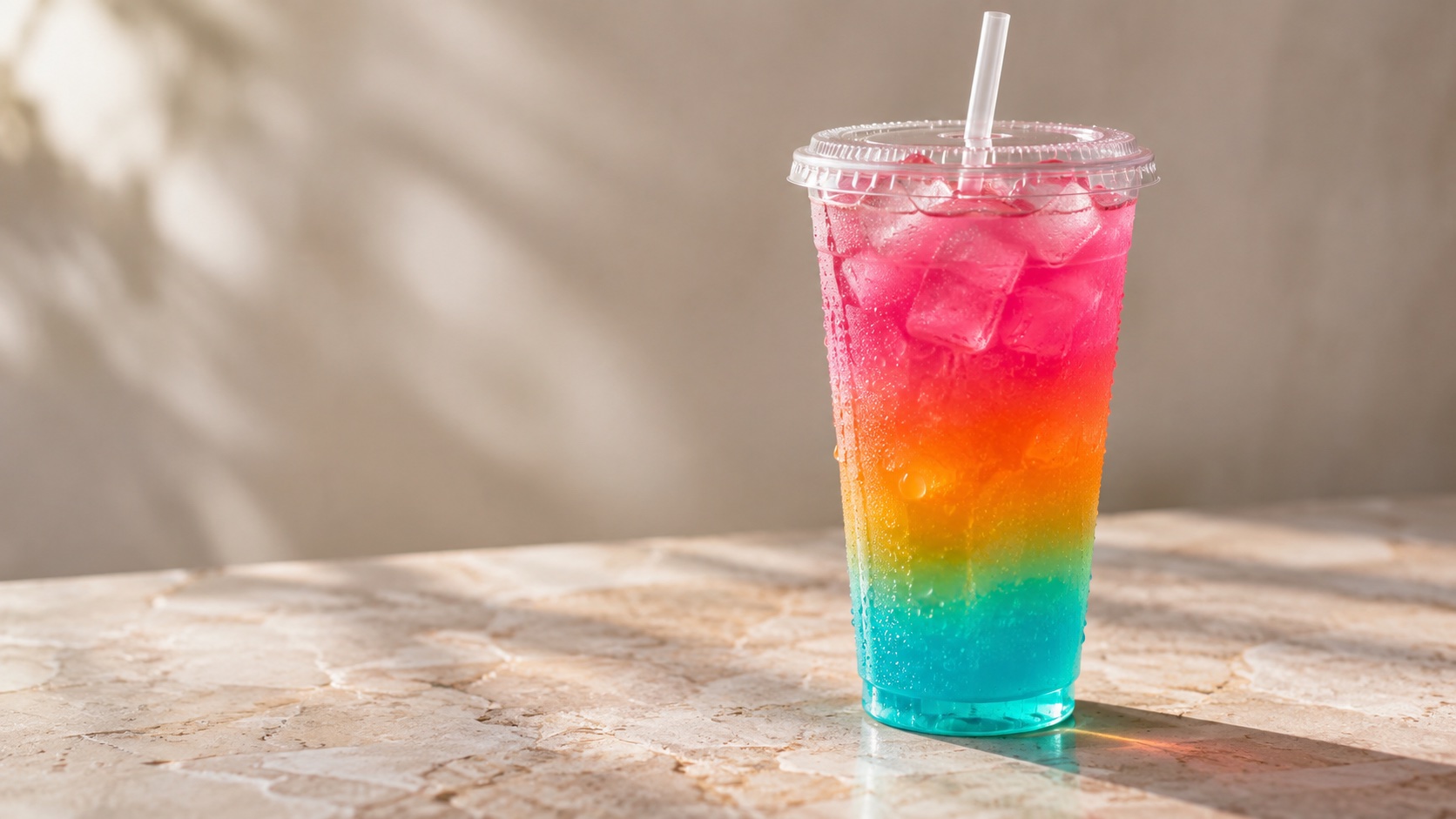
The same need shows up as a soft toy, a drink made to be carried, a candle warmer, a record on the player and a fountain pen.
On the shelf. Record players and fidget toys sell more than a year ago. Weighted blankets sell about the same. Amazon US, sales rank of the leading products, Nov 2025–Oct 2026 against the year before.
Easing nearby
Comfort without an object is flat or falling, and not every physical thing is rising. Things you own and use by hand lean up. Craft classes, instant cameras and metal credit cards are easing.
Tomorrow morning
- Look. Search TikTok for your product plus “unboxing”. See what people touch, squeeze or show first.
- Ask. What is the physical moment in our product, and who is designing it?
- Test. Change one physical detail, such as weight, texture or how it opens, on a small run.
To make it with my hands
“I want to make something with my own hands that doesn’t have to be good, so I pick up the needle, the clay, the paper and the glue.”
The why: no pressure The reason people give most is the freedom of making something that does not have to be good. Then come the feel of the materials and a finished thing they can keep.
A kit that takes a beginner to a finished object, with no way to fail, meets this need. The reward is the object and the feel of making it, so the materials matter as much as the result.
Ask yourself: What could someone make with your product in one evening, and keep?
Seen on TikTok
Tap a card to watch on TikTok. Views as read in November 2026.
“For me it’s a creative release without the need for perfectionism.”
Rising: made by hand, at home
Needlepoint, air dry clay, linocut, junk journaling and sourdough are rising almost across the board: of 39 needlepoint searches, 36 are up and none are down. Starter kits rise with them.
“I like upcycling paper, I like cutting and ripping paper, I like smashing and gluing things down.”
Easing: the app and the class
The app for a personal practice is losing to paper: of 17 journal-app searches, 14 are down. Classes are easing too, as people start at home with a kit. Reading, listening and watching are a different story: e-readers, audiobooks and record players are all rising.
“The tactile feel of the paper is the most important aspect for me.”
On the shelf. About half of the leading junk journal kits were not on sale a year ago. Amazon US, sales rank of the leading products, Nov 2025–Oct 2026 against the year before.
Tomorrow morning
- Look. Search your category plus “kit” and plus “for beginners”. See what people are trying to make for the first time.
- Ask. What would a first-timer finish in one sitting with our product?
- Test. Put together one starter kit and see who buys it.
A reason to be together
“I want company, so I look for something to do with people.”
The why: belonging People rarely search for company itself. They search for the game, the club or the class, and the company comes with it.
The activity is the invitation. A product or a place that gives people something to do together earns the visit, and the company is what brings them back.
Ask yourself: What do people already organize around your category: a night, a club, a league?
Seen on TikTok
Tap a card to watch on TikTok. Views as read in November 2026.
“in my tiny home town with 15k people I started a soccer league, but I'm also considering to start a board game group.”
Rising: things to do together
Games for a table, clubs, group classes and group races are rising. Doing it alone, or through a screen, is easing.
On the shelf. Most of the leading mahjong sets are new listings this year. Party card games for adults do not sell more than a year ago, even as searches for them rise. Amazon US, sales rank of the leading products, Nov 2025–Oct 2026 against the year before.
Tomorrow morning
- Look. Search your category plus “club”, “night” or “with friends”. See what people already organize around it.
- Ask. What could two people do with our product that one cannot?
- Test. Offer one version for a group: a pack, a table, a session.
Take it with you
The full brief as a 19-page PDF, for your team or your next planning meeting. Subscribe to download it and receive the tomorrow& newsletter.
Free. Unsubscribe any time.
How we found it
tomorrow& reads three kinds of evidence together: what people search, what they say, and what they buy.
Search. More than 15,000 Google searches in the United States, each compared over twelve months. Every bar in this brief is one search or one entry from our category studies. Google searches, US: average a month Oct 2025–Sep 2026 and change against Oct 2024–Sep 2025. † most of the change arrived in one month: read the direction, not the size.
People’s words. Reddit threads and TikTok comments, read in November 2026, for the reasons people give. Quotes are shown as written.
Sales. Amazon sales rank for the ten leading products in 16 product groups, the last twelve months against the twelve before. We report it in words: selling more, about the same, or less.
About this brief. This is market research. It describes what people in the United States search for, say and buy; it does not recommend any product, treatment or investment, and nothing in it is medical, legal or financial advice. Some entries concern health conditions and prescription treatments; they are reported as search and conversation, not as guidance. Quotes are public posts, shown as written, and belong to their authors. Videos belong to their creators and are linked for reference; a link is not an endorsement by them or of them. Numbers are our own measurements for the periods stated and can change.
Why it matters
Plan by the need
The product that serves a need today will be replaced. The need will still be there in 2028. A range planned around the need already has its next product in view.
Be specific
Across these needs the named thing is rising: the named treatment, the named material, the named situation. Specific is what people can search for, check and trust.
Design for the hand and the table
Get real is physical and shared. They are met by how a product feels, by what people can make with it, and by what they can do with it together.
See it for your category
Ask Tomorrow&
One question about one need, ingredient or product, answered across social, search and sales. From $500.
Category Snapshots
One category in depth: the needs, the signals behind them and the openings worth testing. $1,250 each.
tomorrow& by Schieber Research · tomorrowandwhy.com